
Marshall County Court Record Requests
One local office stands behind the district court's paperwork. Marshall County Court Administration keeps the case records, registers of actions, hearing details, and copy requests. Before you ask for anything, pin down three things. Get the Marshall County court file number, the exact document or event, and the copy type, whether plain, certified, or exemplified. The best route depends on where the item sits. It may show in Minnesota Court Records Online, sit in a local paper file, or fall under a remote-access limit, and each case points to a different path.
- Search MCRO by case number to identify the register entry or document needed.
- Use the courthouse public-access terminal if the remote view is incomplete.
- Contact Court Administration by phone or visit the counter for local-file, certification, or record-specific help.
- Use the statewide copy-request route by mail, or eFS where the procedure permits it.
- State the requested copy type and follow the payment instructions for any fee-bearing copy.
MCRO, the counter, mail, and eFS where allowed are the documented channels for copies. Calling the office works for clarifying a record or a detail of your submission. It does not replace a complete request. Many in-person copies come the same day under statewide guidance. Off-site records can take longer. The county posts no Marshall-specific turnaround.
Marshall County Record Request Channels
Each channel has its own job. MCRO gives the public Case, Document, Hearing, and Judgment searches. A terminal at the Marshall County courthouse opens fuller electronic access. At the counter, staff help with inspection, copies, and older-file questions. Mail requests follow the statewide instructions. Eligible eFS use is part of a filing-and-service workflow. Court Administration can match the channel to your specific case record.
| Channel | Best use | Important limit |
|---|---|---|
| MCRO | Locate public case details or an available document | Results are unofficial and older online documents are limited |
| Courthouse terminal | More complete public electronic access | Rule 8 restrictions still apply |
| Counter or phone | Local paper records, certification, and procedure | Staff cannot provide legal advice |
| Mail or eFS where allowed | Submit a copy request through the stated process | Verify local submission instructions first |
No county-specific online form is listed. The Minnesota copy-request instructions lay out the statewide process Marshall County follows instead.
Kinds of Court Records
A docket and a court record are kin, not twins. The Register of Actions serves as the index and timeline. The wider Marshall County court file can hold pleadings, motions, affidavits, exhibits, orders, judgments, notices, transcripts, and more. Court Administration handles district-court matters in civil, criminal, family, probate, juvenile, and traffic categories.
- Register of Actions and Case Events
- Pleadings, motions, affidavits, and notices
- Orders, judgments, and disposition documents
- Hearing and calendar information
- Financial entries where the public case view displays them
- Separate transcript requests directed to the court reporter or transcriber
Some records only look like substitutes. City records, police or sheriff investigative files, federal PACER records, and Minnesota DVS driving records are not copies of the Marshall County district-court file.
Marshall County Court File Records
The Register of Actions shows where a document fits in the Marshall County case. Case Events list newest first. An entry may carry an event date. It may also show a description, a document index number, or a View Document control. A hearing entry is not a transcript. A document index is not always viewable from afar. Naming the precise event or document narrows a Marshall County copy request fast.
Bring the case number. Bring the event date, the document title if shown, and the copy type you want. With that, Court Administration can say whether the item is public. The office can also flag if it is locally held, redacted, sealed, or routed through another channel.
Note: A register entry identifies a court-file event. It does not guarantee public remote access to every attached document.
Court Records: What They Contain
MCRO Case Details offers a useful inventory first. The public view can show core case information and the event history. The fuller court record retains the underlying filed material when it exists and is available. Access turns on the record type, Rule 8, any court order, and the line between public courthouse inspection and remote access.
| Case information | File number, title, case type, filed date, venue, judicial officer, status, flags, and related cases where displayed. |
|---|---|
| Register of Actions | Reverse-chronological event timeline, sometimes with an index number or document-view control. |
| Filed material | Pleadings, motions, affidavits, exhibits, notices, and orders retained in the court file as available. |
| Hearings | Upcoming and prior setting information, which should be checked against the local calendar. |
| Transcript | A separate product requested from the court reporter or transcriber, not a standard docket copy. |
Marshall County Court Record Search
MCRO Document Search takes a complete court file number. It returns indexed documents in reverse chronological order, and pairing it with Case Events helps you spot an available item. Viewing documents on MCRO is generally free. When the online record lacks the document, the Marshall County court and its courthouse terminal come next.
Fees enter once the record is identified. The Minnesota district-court fee page is the official source for the copy and certification amounts applied to Marshall County requests.
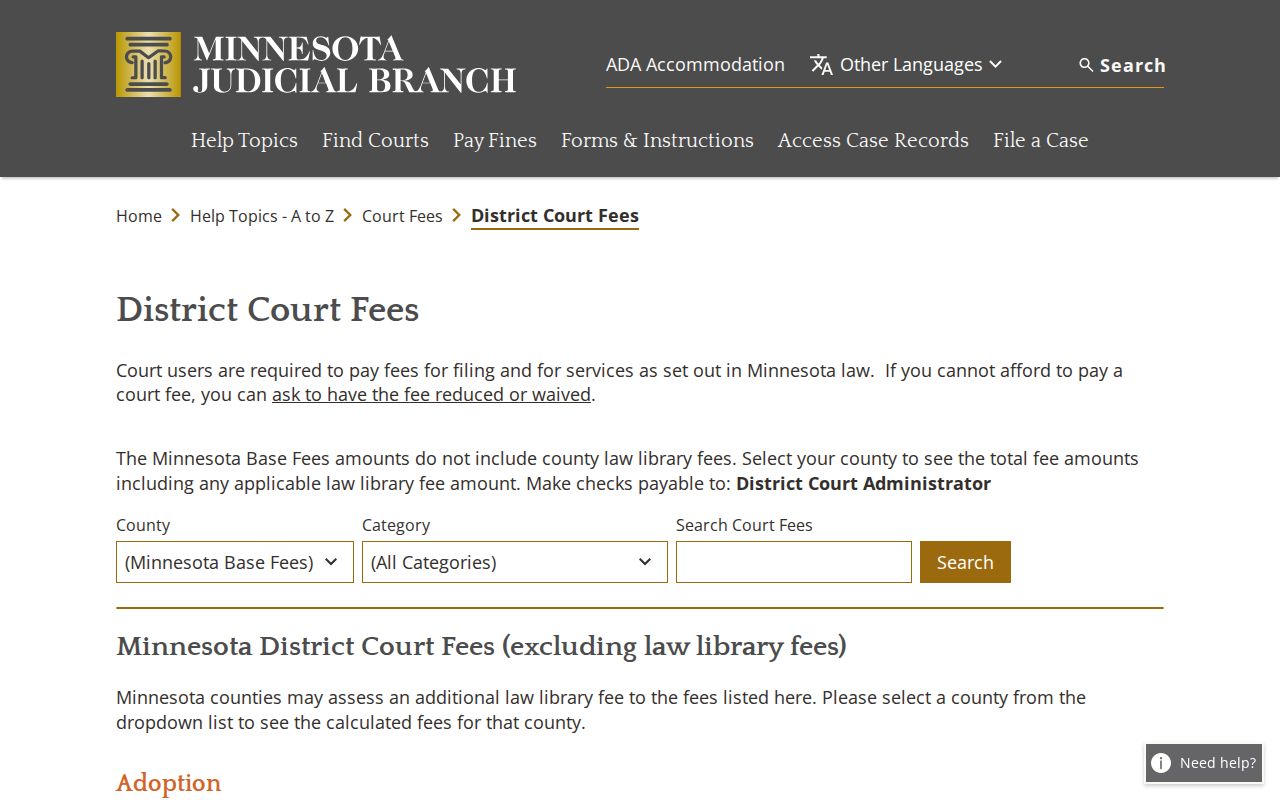
Fee details matter most after you find the record. An uncertified public copy and an authenticated copy are different products.
Marshall County Court Copy Choices
Plain, certified, exemplified: three grades of copy. A plain copy is just an ordinary reproduction. The clerk authenticates a certified copy. An exemplified copy carries a further level of authentication. Certified-plus-exemplified is a combined option. Nothing on MCRO's public display counts as a certified record. Tell Marshall County Court Administration what the copy is for. The office can explain the right request type.
| Item | Statewide fee | Marshall request note |
|---|---|---|
| Uncertified civil or criminal instrument | $0 | Listed as an uncertified copy |
| Uncertified printout, screen, or scan | $0 | Listed statewide as no-charge |
| Certified copy | $14 per document | Clerk-authenticated reproduction |
| Exemplified copy | $14 per document | Request when that authentication is needed |
| Certified and exemplified copy | $28 per document | Combined certification option |
| Case-management report | $5 for 1–50 pages | $25 per 50 pages or part over 50 |
Scanning runs $25 per 50 pages or part of a filing. A county law-library fee may apply, though the county lists no Marshall-specific added amount.
Marshall County Court Administration Records
Minnesota runs a unified district-court administration, so there is no separate Marshall civil clerk or criminal clerk portal. The public local office is Marshall County Court Administration, led in public capacity by Court Administrator Pamala Shaw. It maintains the county district-court records, registers, calendars, hearing information, and copy channels.
Marshall County Court Administration
Marshall County Courthouse
208 E Colvin Avenue, Suite 18
Warren, MN 56762
(218) 745-4921
Monday through Friday, 8:00 a.m. to 4:30 p.m.
The counter helps with inspection, copies, older paper records, and transcript-request routing. It cannot decide the legal purpose of a request. For district-level court context, the Ninth Judicial District page covers Marshall County's place in it.
Copy Fees and Certification
Certified and exemplified copies can be paid for by credit card, or by check or money order made out to the District Court Administrator. Confirm the mailing directions for Marshall County before you send anything in. There is no county-specific request form. Name the exact document and certification type in your letter. Documents held off-site take longer. Ask Court Administration about extra time rather than counting on same-day service.
A certified copy is not just any printout or scan. It is the clerk's own authentication of the reproduction. MCRO can help you locate the case, but the certified court record itself comes from the local office. That distinction matters when the copy must be official.
Marshall County CON101 Record Access
Not everything in a Marshall County court file is available through an ordinary public records request. Minnesota calls its special application the CON101, a Request for Access to Confidential or Sealed Record. The form asks for the county, the court file number, the judicial district, the case type, the specific records sought, the requester's interest and reason, and contact details. Filing it is not a search shortcut. Access is never guaranteed.
The official CON101 form page shows the request used for confidential or sealed court records. It includes the form itself and its instructions.
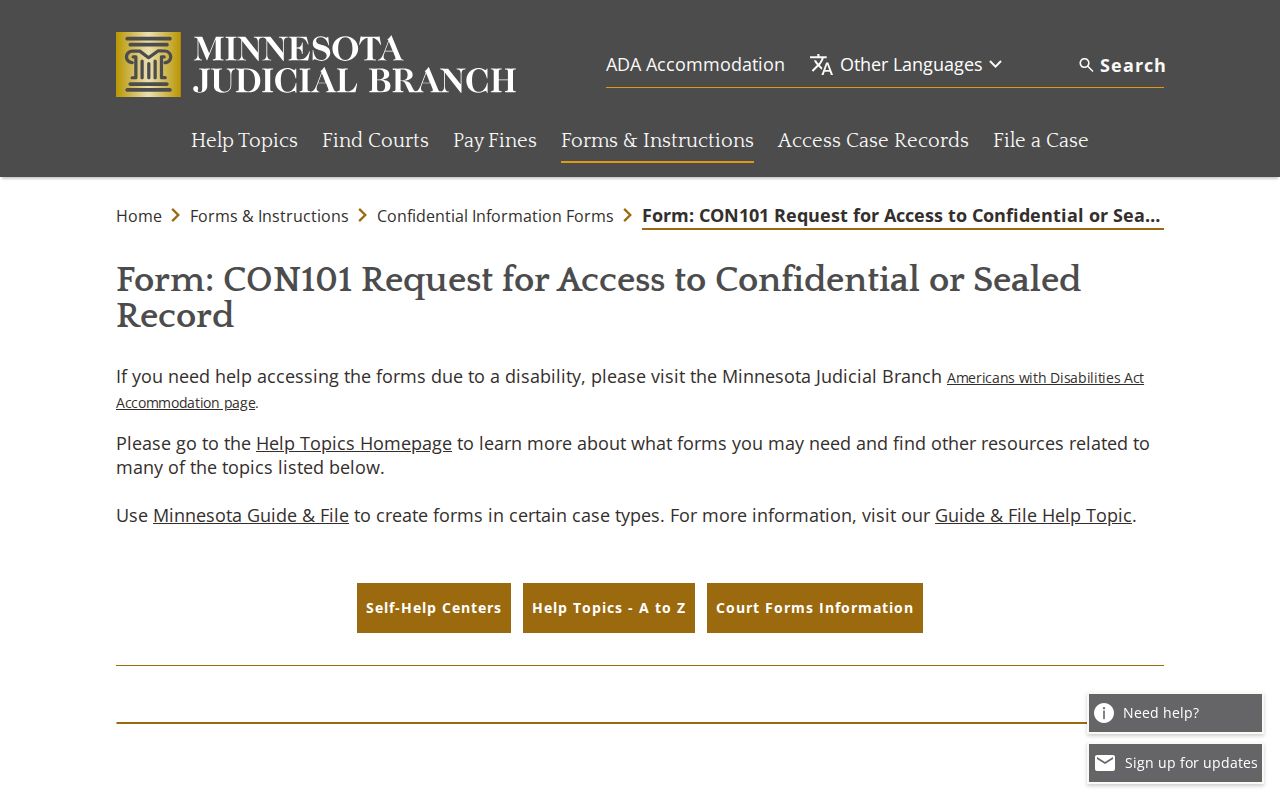
The court makes the access decision after the form is reviewed. Adoption records follow a separate process, and parties seeking confidential material may need to verify identity.
Access Rules for Court Records
Minnesota General Rules of Practice Rule 8 governs public access to court records. It allows inspection and copying of public original records where they are normally kept, during regular hours. Remote access is narrower. The Minnesota Government Data Practices Act presumes data are public. But judicial-branch data get separate treatment. That leaves Rule 8 as the controlling framework for court-record access.
Marshall County access rules:
Rule 8 covers public court records, registers of actions, calendars, and remote-access limits.
Minnesota Statutes Chapter 13 supplies the public-data framework but does not replace Rule 8 for court records.
Minnesota Statutes Chapter 609A provides Minnesota’s expungement and sealing process.
Protection-order, juvenile, child-protection, commitment, and certain family materials may be restricted or unavailable remotely. A restricted flag says nothing about how the case was decided.
Marshall County eFS Record Access
Minnesota eFile and eServe, known as eFS, is a system for filing and serving documents. It is not a public records portal. Attorneys, government agencies, and guardians ad litem generally must eFile. Self-represented filers may use it if they wish. Paper filing remains open to anyone not required to file electronically. Criminal charging documents are an exception. They do not go through eFS at all.
Documents filed through eFS carry public, confidential, or sealed security levels. If a normally public document is marked confidential or sealed, the filing process should identify the authority behind that level. A 2024 eFS notice also explains that document links require email authentication. Whatever gets accepted still belongs in the court file. Public copies may appear through MCRO where available.
Marshall County Older Court Records
MCRO warns that online documents from before July 1, 2015 are very limited. That is an access problem, not proof the case or the paper file is gone. Start with the complete case number. Then review Case Events. Try the courthouse terminal. Ask Court Administration about a locally held or off-site record. Is the question a hearing date? The Marshall County daily calendar is a separate local source. If staff direct you there, a mail request may be the next step. A restricted-access form may be too.
The Minnesota court-form index gathers the confidentiality and court-record forms used when ordinary remote access will not reach the file.
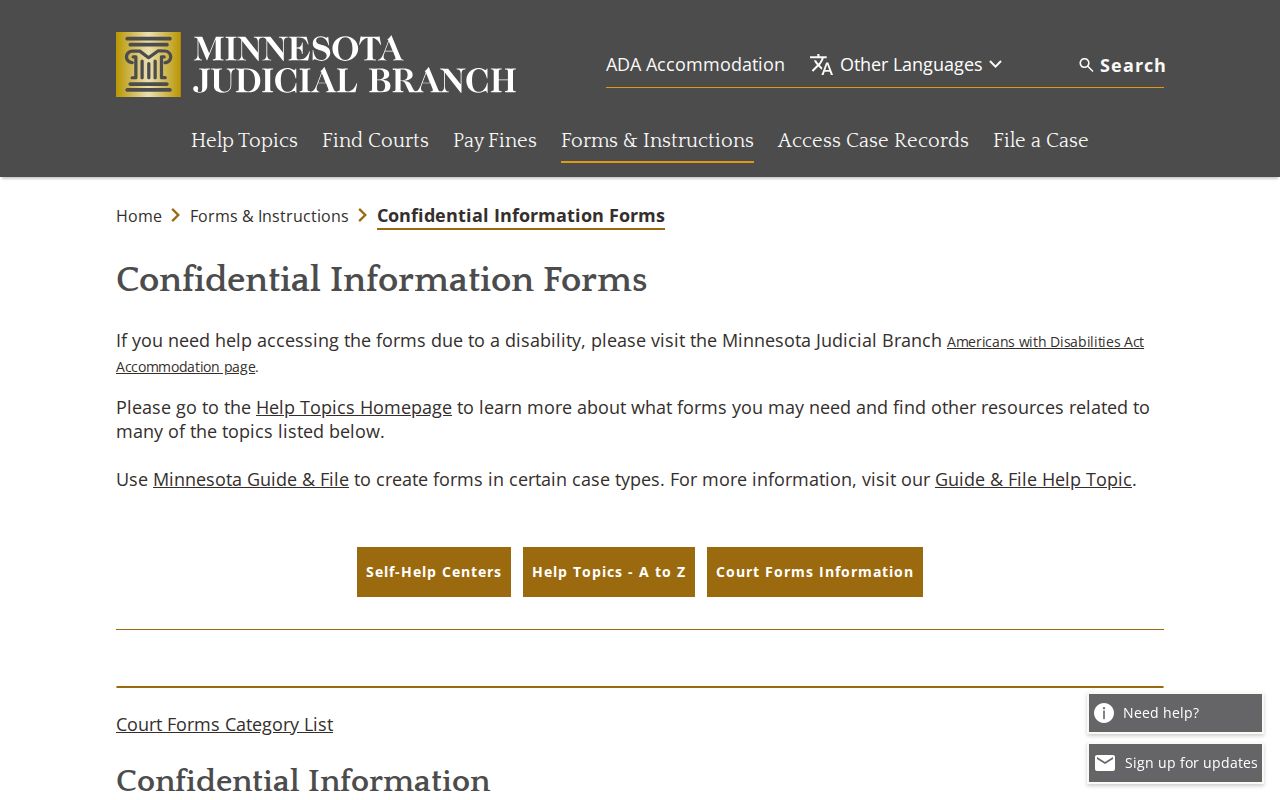
The form index supports the court's formal process. For a particular Marshall County file, Court Administration can identify the local route.